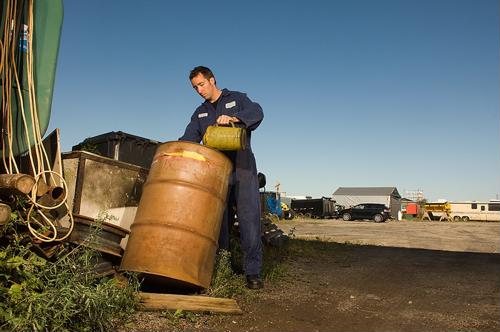
Due to the nature of their primary working medium, those employed in a trade such as barrel refurbishing are at risk for exposure to various chemical compounds and other hazardous substances, and thus must observe strict safety procedures to protect themselves. Toxicity risks are present in many heavy industrial jobs, and as such, those who take them become accustomed to using the safety equipment and best practices that are necessary to get their work done.
When workers don't receive the proper tools or training to safely handle their responsibilities in factories and other work sites where exposure to hazardous substances is a possibility, dangers increase exponentially. All things being equal, there would be no question about who was to blame for this breach of workers' safety – the business itself, so long as employees weren't behaving in a willfully negligent manner. But waters often become muddied in circuitous legal machinations and the back-and-forth between companies and staff. The case of a barrel refurbishing plant in the Milwaukee metropolitan area, which was recently penalized by the Occupational Safety and Health Administration for noncompliance, illustrates how complex such a situation can become.
Hazard may date back to 2010
Greif, Inc., a packaging corporation engaged in a variety of verticals across that sector, added barrel refurbishing and reconditioning to its catalog of business services in 2010, through the absorption of another firm called Container Life Cycle Management.
As detailed in an long-form investigative report by the Milwaukee Journal-Sentinel, the potential dangers of the field are well-known, due to the flammability, toxicity and general instability of the substances often contained in the drums and barrels that were being revamped. Greif established six CLCM facilities throughout Wisconsin and structured its ownership of the firm in a manner intended to avoid liability for any incidents. This would prove prudent, as the next seven years would feature numerous examples of improper chemical disposal, fire and various injuries to workers, including respiratory problems, burns (from both heat and corrosive chemicals) and lacerations or contusions from the debris of exploding barrels.
OSHA citations issued after senator's demand
Near the end of July 2017, U.S. Sen. Tammy Baldwin, D-Wisc., who had heard numerous accounts of accidents, injuries and improper safety practices from her constituents, penned a stern letter to OSHA Deputy Assistant Secretary of Labor Dorothy Dougherty: The missive demanded that the federal agency conduct investigations of the CLCM facilities in St. Francis and Oak Creek, despite the lack of direct employee complaints, which, historically, are the impetus for OSHA inspections despite not being a requirement for their occurrence. Baldwin did not mince words in her request.
"What is most shocking is that OSHA has again neglected to cite the company for willful violations, despite what appears to be clear evidence of the company's knowledge of the regulations [it] was violating," the senator wrote.
OSHA honored Baldwin's requests and investigated the two aforementioned plants, finding evidence of nearly all alleged instances of noncompliance and violation. The regulatory department announced its issuance of two citations and five violations to the St. Francis plant on Feb. 1, 2018, which were grounds for financial penalties of $15,550. Combined with the results of inquiries into the Milwaukee and Oak Creek CLCM facilities, OSHA issued 14 citations and 26 violations regarding these three work sites, leading to $128,000 in fines altogether.
CLCM issuing official denials
A separate piece in the Journal-Sentinel also noted that CLCM was filing disputes regarding most of the newest violations it received, with the exception of the charges levied regarding improprieties at the Oak Creek plant. It's also contesting many of the 70 total violations held against it by regulators from multiple agencies at the federal and state level, 20 of which are hazardous waste and air pollution charges from the Environmental Protection Agency. Because none of those 20 censures have been settled as of Feb. 2, ostensibly due to pushback from CLCM and Greif, the EPA may file a federal lawsuit against the company.
Rumors of compliance staging
The company's seeming belligerence and unwillingness to budge regarding nearly all of the negligence allegations levied against it becomes more understandable when taking into account reports of previous government citations that CLCM and Greif have ignored. Moreover, rumors persist that management attempted to "stage" examples of its operations to appear perfectly compliant, in the hopes of reassuring OSHA inspectors, before reverting to its business as usual. OSHA stated that its own inspections are never announced, to preclude such disingenuous behavior, but that it knew nothing of any specific attempts to do so by CLCM.
Nevertheless, reports from numerous regulators allude to actions that seemed duplicitous, and a whistleblower in the company leaked recordings of internal conversations and a variety of documents that seem to back up such conclusions. Perhaps most damaging of all is the fact that after a surprise inspection the EPA conducted on several of the barrel refurbishing work sites, two of the agency's employees suffered from respiratory problems, nausea and dizziness.
How this all turns out for CLCM or Greif remains to be seen, but at this point, considerable evidence exists to support the accusations of unsafe chemical handling and other noncompliant practices.