What is Fensulfothion?
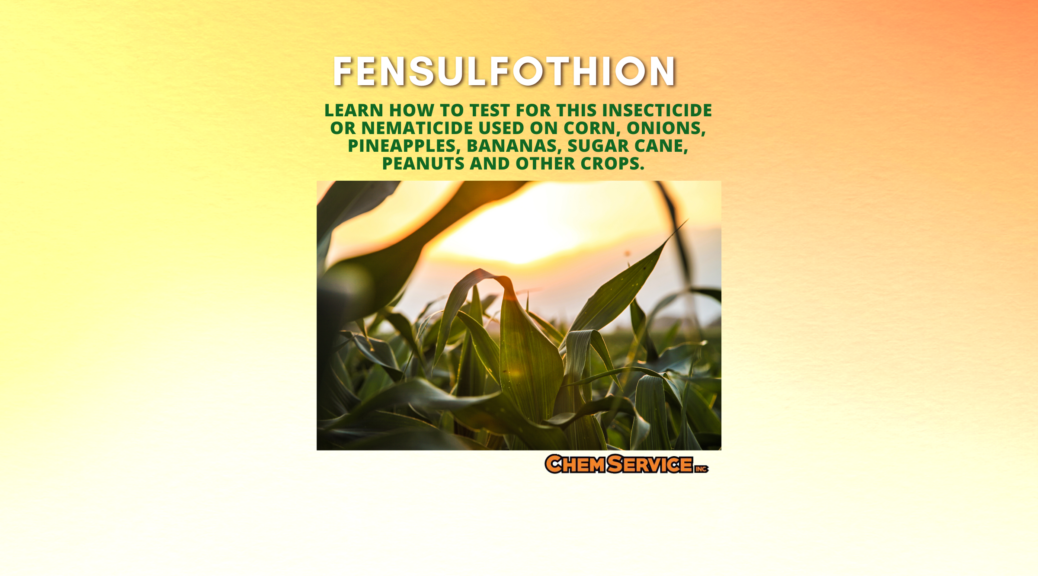
Fensulfothion is a brown or yellow oily liquid that stable under normal use conditions, but also highly toxic and hazardous. It is widely used as an insecticide or nematicide on corn, onions, pineapples, bananas, sugar cane, peanuts and other crops. This is a moderately persistent chemical that has a half-life of 30 to 40 days in most soils and a half-life of about two weeks in water.
Is Fensulfothion Toxic or Harmful to the Environment and is it Regulated?
Due to its pesticide nature, Fensulfothion is considered a hazardous substance by the American Conference of Governmental Industrial Hygienists (ACGIH), the National Institute for Occupational Safety & Health (NIOSH), the Department of Environmental Protection (DEP) and the U.S. Environmental Protection Agency (EPA). In addition to killing insects, worms, or weeds, it can also be toxic to other organisms such as birds, fish, and other non-target plants by contaminating the surround areas soil, water, turf, and vegetation.
It is registered for use as a preplant or at-plating soil application or post-plant application to select agriculture. Fensulfothion is formulated into a 63% (6lb/gallon) mixture that has restricted use, or in 10% and 15% granular.
What are the 5 Fensulfothion Degradation Products (Metabolites) and How are They Formed?
The 5 Fensulfothion degradation products are Fenthion oxon, Fenthion oxon sulfoxide, Fenthion oxon sulfone, Fenthion sulfoxide, and Fenthion sulfone. The metabolites are produced as a result of the metabolism in animals, plants, and their surrounding environments through oxidation or hydrolysis. The type of environments has a direct correlation to the creation of the kind of Fensulfothion degradation product that is produced. For example, as it has been found that in the transformation of fenthion in fish leads to the formation of two metabolites, fenthion sulfoxide and fenthion oxon, while the predominant metabolite found in plants is fenthion sulfone.
How do you Measure and Test for Fensulfothion?
Measuring Fensulfothion can be done using a couple of different approaches dependent on the source of the chemical. Airborne exposure is measured by the inhalable fraction and vapor in the air and tested through gas chromatography-mass spectrometry. If it is absorbed through your skin, plasma and red blood cell cholinesterase levels can be tested by using Ultra-High Performance Liquid Chromatography-Tandem Mass Spectrometry, which is generally the preferred method to test for Fensulfothion.
How do you Obtain Fensulfothion Samples?
Due to its excellent performance and broad range of applications, the QuEChERS (quick, easy, cheap, effective, rugged, and safe) method has become a popular sample preparation method.
How Long does Fensulfothion Last in the Body and Can you Get Rid of it?
Fensulfothion can affect you through your skin or when breathed in and can cause a variety of symptoms ranging from acute intoxication to organophosate-induced intermediate syndrome (IMS), and even death. If exposure stops, plasma levels should return to normal within 1-2 weeks while red blood cells may be reduced within 1-3 months.
How can Chem Service Analytical Standards be used to Test for Fensulfothion?
Fensulfothion can be found in a variety of agricultural products due to its broad-spectrum applicability and a reliable testing method for determining residue levels is necessary to evaluate food safety and risks to human health. Chem Service uses the highest level of purity of each metabolite and analytical standards for all of our products to help ensure you receive accurate results. Contact the Chem Service team for help in determining which product is right for your needs.
Sources:
- Aktar, Md Wasim, et al. “Impact of Pesticides Use in Agriculture: Their Benefits and Hazards.” Interdisciplinary Toxicology, Slovak Toxicology Society SETOX, Mar. 2009,
- “Fensulfothion Hazard Summary – NJ.” Hazardous Substance Fact Sheet, NJ Department of Health Services, June 2005.
- Lee, Jonghwa, and Jeong-Han Kim. “Simultaneous Analysis of Fenthion and Its Five Metabolites in Produce Using Ultra-High Performance Liquid Chromatography-Tandem Mass Spectrometry.” Molecules (Basel, Switzerland), MDPI, 22 Apr. 2020.
- Meyer E;Borrey D;Lambert W;Van Peteghem C;Piette M;De Leenheer A; “Analysis of Fenthion in Postmortem Samples by HPLC with Diode-Array Detection and GC-MS Using Solid-
- Phase Extraction.” Journal of Analytical Toxicology, U.S. National Library of Medicine, 1988.
- P. JunqueraLast Updated: July 28 2021. “Fenthion Safety Summary for Veterinary Use in Dogs, Cats, Horses, Cattle, Sheep, Goats and Swine. Toxicity, Poisoning, Intoxication, Overdose, Antidote.” PARASITIPEDIA.net,
- Vagi, Maria C., et al. “Toxic Effects of the Organophosphorus Insecticide Fenthion on Growth and Chlorophyll Production Activity of Unicellular Marine Microalgae Tetraselmis Suecica: Comparison between Observed and Predicted Endpoint Toxicity Data.” IntechOpen, IntechOpen, 27 Dec. 2017,