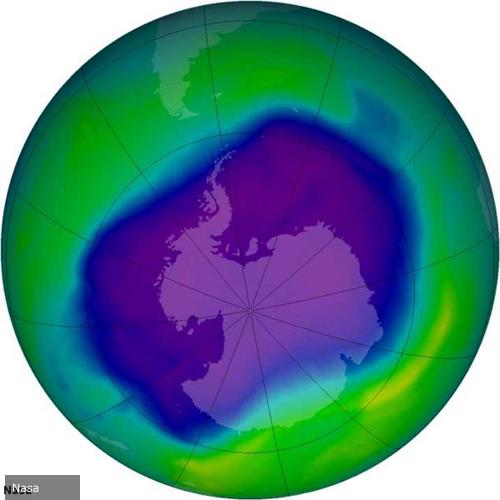
Although there's been considerable debate on the global stage regarding the safety of various chemical compounds, few can debate whether chlorofluorocarbons are dangerous: It's been widely established that these substances can harm human beings in the short term and – much more alarmingly – cause depredation of Earth's ozone layer over time.
The discovery of the hole in the ozone layer during the 1980s prompted near-immediate action, with world governments agreeing to the Montreal Protocol in 1987: Production of all CFCs immediately came to a halt, along with the creation of any related chemicals, according to MIT Technology Review. Many of them earned permanent bans, aside from a few with medical applications. But recently, scientists took notice of a sudden rise in emissions of a particular CFC: trichlorofluoromethane, more casually referred to as CFC-11. An investigation led to the discovery of Chinese factories using this illegal chemical, and the findings could have a considerable impact on the environment, the chemical industry and possibly global politics.
China's struggle to regulate certain chemicals
The People's Republic is one of the biggest global players in the chemical sector, with production of many perfectly legal substances, particularly petrochemicals, having served a major purpose in galvanizing growth of the Chinese economy during the last few decades. However, The New York Times pointed out that for much of this rapid expansion period, little to no enforcement occurred to control what went into the production of these chemicals as precursor materials, or the use of illegal substances in the manufacturing of many consumer products.
As a result, the Chinese government is now hurrying to play catch-up and curb the presence of dangerous chemicals before they make the nation's already considerable pollution problems any worse.
Uses and dangers of CFC-11
CFC-11's most prominent use was in the creation of foam used to insulate buildings and refrigerators. (The compound bears notable similarities to various perfluoroalkyls, historically included in the manufacture of firefighting foam and now known by the Centers for Disease Control and Prevention to engender significant health problems, but unlike CFC-11, PFASs aren't believed to significantly affect the ozone layer.)
According to the profile and environmental impact assessment of CFC-11 completed as part of the International Programme for Chemical Safety, its environmental hazards don't extend beyond what it can do to ozone, but it has quite a few more immediate dangers to humans. It produces multiple toxic gases, including hydrogen chloride and carbonyl fluoride, and sizable amounts in the air can rob it of oxygen and kill anyone present. Also, the substance itself can cause immediate damage to the cardiovascular workings of the body and the central nervous system, and long-term exposure breaks down the skin.
Discovery of CFC-11 in refrigeration equipment factories
A long-term investigation published July 24 by the NYT identified one of these factories, a refrigerator production facility in the Shandong Province city of Xingfu, as a noteworthy culprit in the spike of CFC-11 emissions. In fact, reporters were present when factory owner Zhang Wenbo was served a notice of mandatory closure by Chinese environmental regulatory officials. Before this took place, Zhang acknowledged use of the material but said he didn't know it was dangerous.
"You had a choice: Choose the cheaper foam agent that's not so good for the environment, or the expensive one that's better for the environment," Zhang stated to the news provider. "Of course, we chose the cheaper foam agent. That's how we survived. They never told us until last year that it was damaging the atmosphere. Nobody came to check what we were using, so we thought it was OK."
Issue may not be limited to China
The Environmental Investigation Agency, an independent watchdog group, identified eight factories in four Chinese provinces that employed CFC-11 in their processes, with the organization cultivating intelligence and developing confidential sources within the facilities themselves to get to the heart of the matter. Some of these companies only used the substance to create their foam products, an action that EIA Executive Director Alexander von Bismarck referred to as "devastating, with massive potential impact on the climate and the ozone layer" in a statement on the investigation.
However, it remains unclear whether this issue is present solely in the Chinese foam industry or if the spike in CFC-11 emissions also stems from the use of the compound elsewhere in the world. Erik Solheim, head of the United Nations Environment Program, told the NYT he didn't necessarily think it was an isolated issue.
"At the same time, we have to dig deeper," Solheim said. "Based on the scale of detected emissions, there is reason to believe the problem extends beyond these uncovered cases."
Currently, the governments of the U.S. and China are engaged in conflict over trade, due largely to steel production, but the issue has spread to the chemical sector, an industry vital to both countries, according to Chemical and Engineering News. The broader effects of American tariffs on the overall Chinese chemical market could indirectly help limit the development of new CFC-11 quantities, but it's not clear whether this would simply push its production into new regions, and the collateral damage to the legitimate chemical producers in China could be devastating.