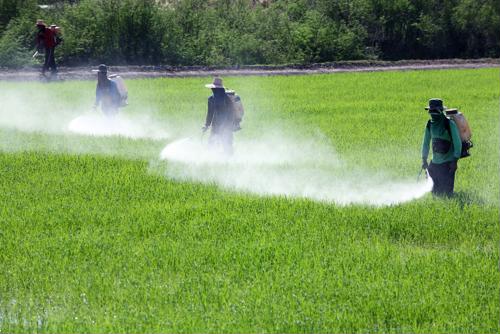
Across the U.S., the use of pesticides has been a major concern for some time now, not only because of the potential environmental harm they pose, but also because of the effects they could have on humans. As such, lawmakers at the state and federal level are trying to figure out new ways to navigate the risk without substantially affecting agribusiness at the same time.
Recent data suggests more than 9 in 10 Americans today have at least some pesticides or pesticide byproducts in their bodies as a result of widespread use of these chemicals, according to the Food and Environment Reporting Network. About 70 percent of all produce in the U.S. have trace amounts of pesticides on them, from hundreds of different chemical compounds that could be harmful to people who consume them.
In large enough quantities, even those considered safe to consume can have detrimental effects on a person's health, the report said. This is especially true for children.
"We look at how EPA has been approving pesticides and setting those tolerances and find again and again that the agency's not taking into account children's heightened susceptibility to pesticides," Olga Naidenko, senior science adviser for children's environmental health at the nonprofit Environmental Working Group, told FERN.
A long-term problem
The rise of modern pesticide use began in the late 1940s, and for the most part, lawmakers have always allowed relatively loose regulatory conditions for companies producing and using these chemicals, according to Elena Conis, a professor at the University of California, Berkeley Graduate School of Journalism and Center for Science, Technology, Medicine and Society, writing for The Washington Post.
This includes the ability of companies to submit new products to the Environmental Protection Agency without necessarily having to file safety information about them, Conis noted. This kind of "conditional registration," as it is known, is in widespread use for chemical companies; about 2 in every 3 drugs are registered without complete testing data, at least initially. Some legal experts consider this a loophole, because chemicals are sometimes allowed to remain on the market for decades without additional safety filings.
An ongoing issue
At the same time as the U.S. government has long gone with lax regulation, it may soon also crack down on the ability of individual states to set rules above and beyond the federal limit, according to Yankton, South Dakota, radio station WNAX. Current federal law allows states to set their own rules at the local level, based on specific need, but there are concerns the EPA is ramping up to no longer allowing that to happen, perhaps making the change in the near future.
The National Association of State Department of Agriculture recently wrote to top EPA officials asking them to continue allowing states to abide by federal rules while also instituting more localized requirements as needed, the report said. Whether that actually happens remains to be seen.
Pesticides are a big issue in the U.S. and will likely continue to be for the foreseeable future. For that reason, consumers, businesses and regulators alike would be wise to keep a close eye on how regulatory controls continue to develop at the state and federal levels.