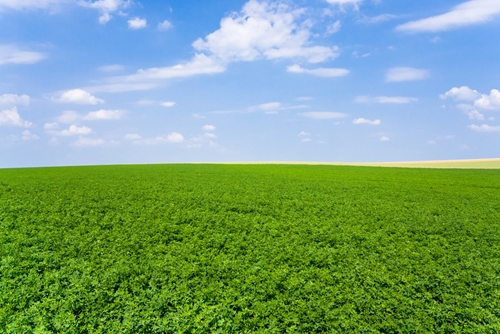
California experienced a severe drought earlier this year and several times in the recent past. While there are a number of causes for this situation, one crop that's rarely discussed keeps making the news: Alfalfa.
This leafy green vegetable is a common feed source for cattle in the dairy and beef industries. However, it isn't getting press because it's a great option for cattle feed – it's one of the most water intensive crops in California – the state with the most dairy cows, Business Insider reported.
Using data from the California Department of Water Resources, The Huffington Post reported that alfalfa is the most water intensive crop, outpacing other commonly discussed water-users including almonds and pistachios. Between 2001 and 2010, Alfalfa required 1.88 trillion gallons of water. That's more than 800 billion gallons more than the next closets crops, pastures, almonds and pistachio. It's nearly three times what corn and cotton required.
Meat, which alfalfa is mostly produced for, was by far the consumer product that used the most water in the state.
Stats may be misleading
However, some of the statistics surrounding alfalfa and its water usage may be misleading, Western Farm Press explained. While it is definitely the biggest user of water, the publication explained that this is largely due to the fact that there's so much acreage in California and it can be grown all year long. When alfalfa is mature it uses roughly as much water as spinach, corn or many other crops, the Press noted.
"If spinach were continually grown on 850,000 to 1 million acres all year long, water use would be about the same as alfalfa, perhaps more," The Western Farm Press explained. "Further, it's not so much how much water is used, but how much crop is produced per unit of water that is important – also known as water-use efficiency. In this category, alfalfa shines. Alfalfa has a range of biological characteristics that make it very useful when a farm or an irrigated region is faced with drought conditions and resulting water limitations."

Western Farm Press argues that alfalfa is actually beneficial during a drought because it has high yields for a crop, it's a perennial, it uses water efficiently and it has deep roots to get all the moisture it needs.
Alfalfa and pesticides
Alfalfa is a commonly grown crop in the U.S. when the climate is right. But in order to capitalize on the high yields that Western Farm Press mentioned, you have to fight off the pests that can ruin the crop. Here are a few of the most commonly used pesticides for alfalfa:
- Diuron and Velpar – The Agriculture and Natural Resources department of the University of California pointed to these herbicides as popular with alfalfa.
- Chlorpyrifos – Better known as Stallion, this insecticide is important for fighting off moths, weevils, aphids and other pests with alfalfa and many other crops.
- Sulfur – According to Pesticide Action Network, sulfur is the most applied pesticide to alfalfa per pound.
There are a number of other pesticides used with alfalfa to ensure high yields as well. Roundup Ready® alfalfa is a popular Monsanto product as well.