When it comes to fertilizer and similar chemical compounds, many farmers find themselves in the middle of a balancing act. On the one hand, they need to make sure their crops receive enough of the nutrients they need to produce maximum yields. On the other, they also have to be careful to apply the fertilizer in a way that minimizes leaching away from the planting soil, which not only deprives the plants of their nutrients but also pollutes local watersheds and contributes to eutrophication.
Controlled-release fertilizers, or CRFs, were developed as a way of fertilizing crops in a sustainable and gradual fashion that would minimize water contamination. Although CRFs are a valuable resource for farmers, researchers are still trying to figure out the best ways to apply them to the soil. One team of scientists from Virginia Polytechnic Institute and State University examined three common CRF application methods and measured the amount of nutrient leaching associated with each one, as published in the journal HortScience.
Issue 'has received little attention'
Lead author James Owen, Jr., explained that the point of his team's experiments was to find the most advantageous technique for fertilizing crops and conserving expensive resources for nursery farmers.
"The use of CRFs has been demonstrated to be effective in reducing nitrogen and phosphorus runoff when compared with systems where dissolved nutrients are applied through irrigation water, Owen and his colleagues said in a statement. "However, the movement of dissolved nutrients through a soilless substrate during the application of water (i.e., during irrigation) has received little attention … We hypothesized that nutrient distribution throughout a substrate profile is affected by the placement of CRF in the container and that this distribution affects the pattern in which nutrients are leached from the container during individual irrigation events."
Owen and his team focused on three main CRF application techniques. As described by experts from Oregon State University and the University of California, topdressing applies CRFs to the substrate surface, which allows the fertilizer to be released as it moves its way toward the root system. Incorporating mixes the CRFs into the substrate prior to planting. Finally, dibbling adds a pre-measured amount of CRFs into holes augured during the potting process.
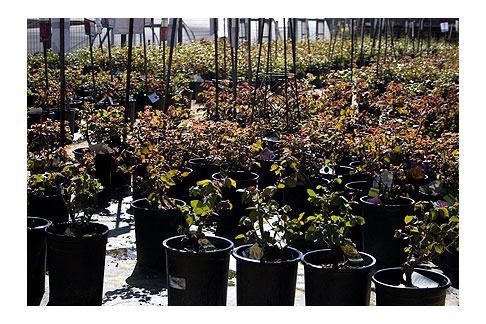
For their experiments, the researchers monitored several plants in which CRFs were applied using these three main methods. As a control, the scientists also observed plants that were not fertilized at all. All plants were growing in a substrate of pine bark and sand that was mixed in a 9:1 ratio. The effluent of the plants following irrigation was analyzed at weeks 3, 9 and 15 after potting.
Results showed that nutrient concentrations were highest in the effluent of the topdressing and incorporated CRF applications, spiking in the fist 50 milliliters of outflow. Meanwhile, the nutrient leaching for the dibbled pots peaked after 150 milliliters of outflow. The authors suggested that dibbling was the most advantageous method of applying CRFs, adding that nutrient leaching is reduced when effluent volume is kept low.
Reduction of leaching may protect environment
Minimizing the amount of nutrients that end up in effluent water can also have a positive impact on the environment. Currently, environmental scientists are concerned about the eutrophication of various watersheds around the world. According to the U.S. Environmental Protection Agency, excessive contamination of watersheds with nitrogen, phosphorus and other nutrients commonly found in fertilizers can lead to overpopulation of algae. The drives bacterial growth and depletes the oxygen supply, thus creating dead zones in the water that cannot support aquatic life.
Although CRFs promote prudent fertilizer use, the way in which CRFs are applied is also impactful. Studies such as the one from Virginia Tech may provide valuable guidance for nursery farmers.